
COMING SOON TO THE CERN SHOP
Inspired by electronic circuit boards developed at CERN, these distinctive notebooks celebrate the engineering and technology behind scientific research.
-
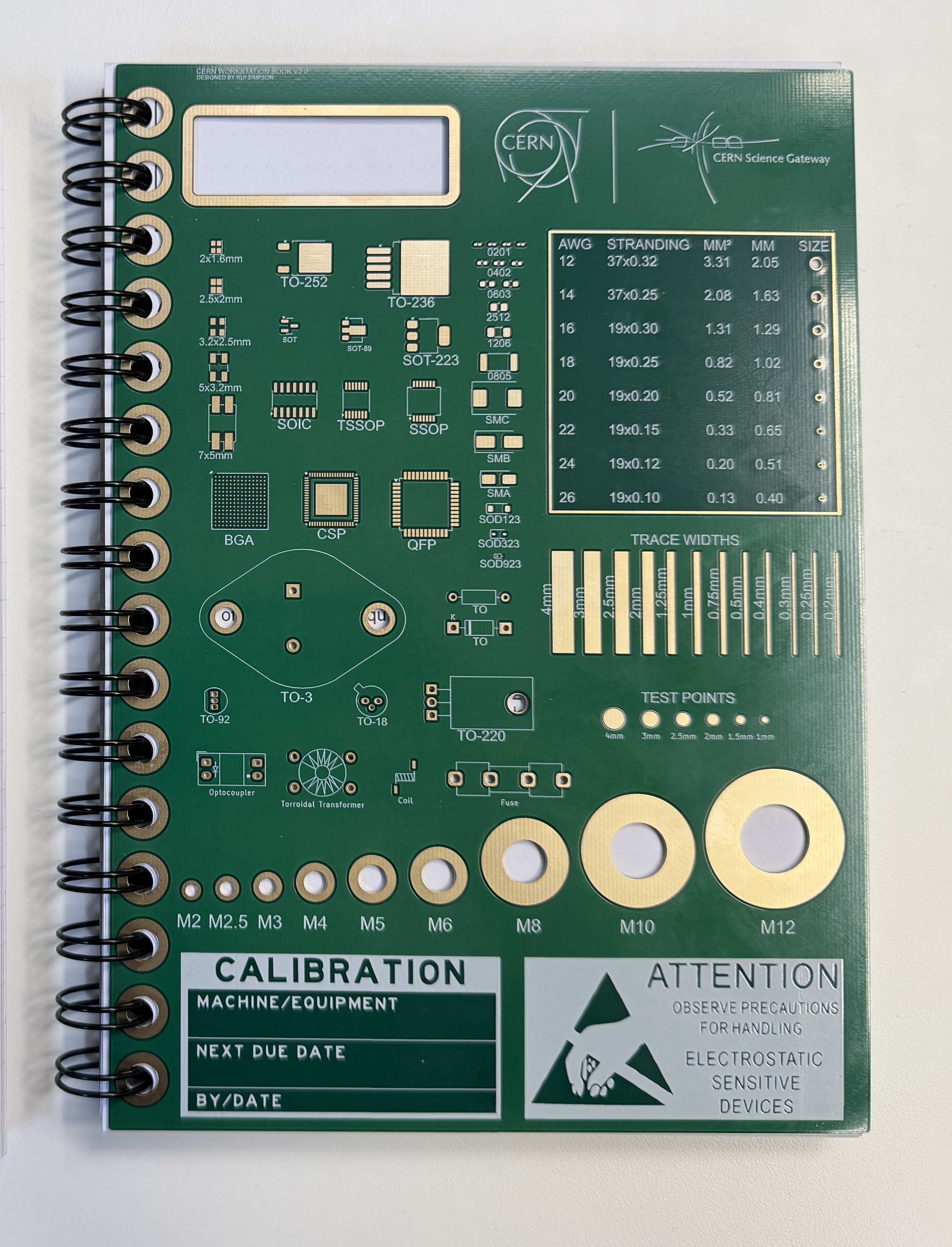
Workstation Circuit Board Notebook — Standard Electronic Components
The CERN complex consists of particle accelerators spanning decades of technological progress. From the oldest, the Proton Synchrotron (1959), to the largest, the LHC (2010), and the newest, the ELENA ring (2020), each of these accelerators has incorporated the latest technological developments available at the time and relied on simple, standardised electronic building blocks.
Throughout the journey from hand-wired custom components to today’s precise surface-mounted chips, CERN has been at the forefront of developing the innovative technologies required to understand the Universe.
The result? Today, CERN operates kilometres of superconducting magnets cooled to temperatures lower than those of outer space, with particle beams travelling through vacuum pipes emptier than space itself. When particles collide, they are recorded by detectors made up of semiconductors and sensors that are capable of measuring positions and timings with micrometre and nanosecond precision.
From transistors and logic gates to FPGAs, the component footprints shown on the front of this notebook represent technologies that are used throughout the CERN complex but can also be found in any electronic device, such as your phone. The limit lies not in the components themselves but in the imagination of the engineers using them.
-
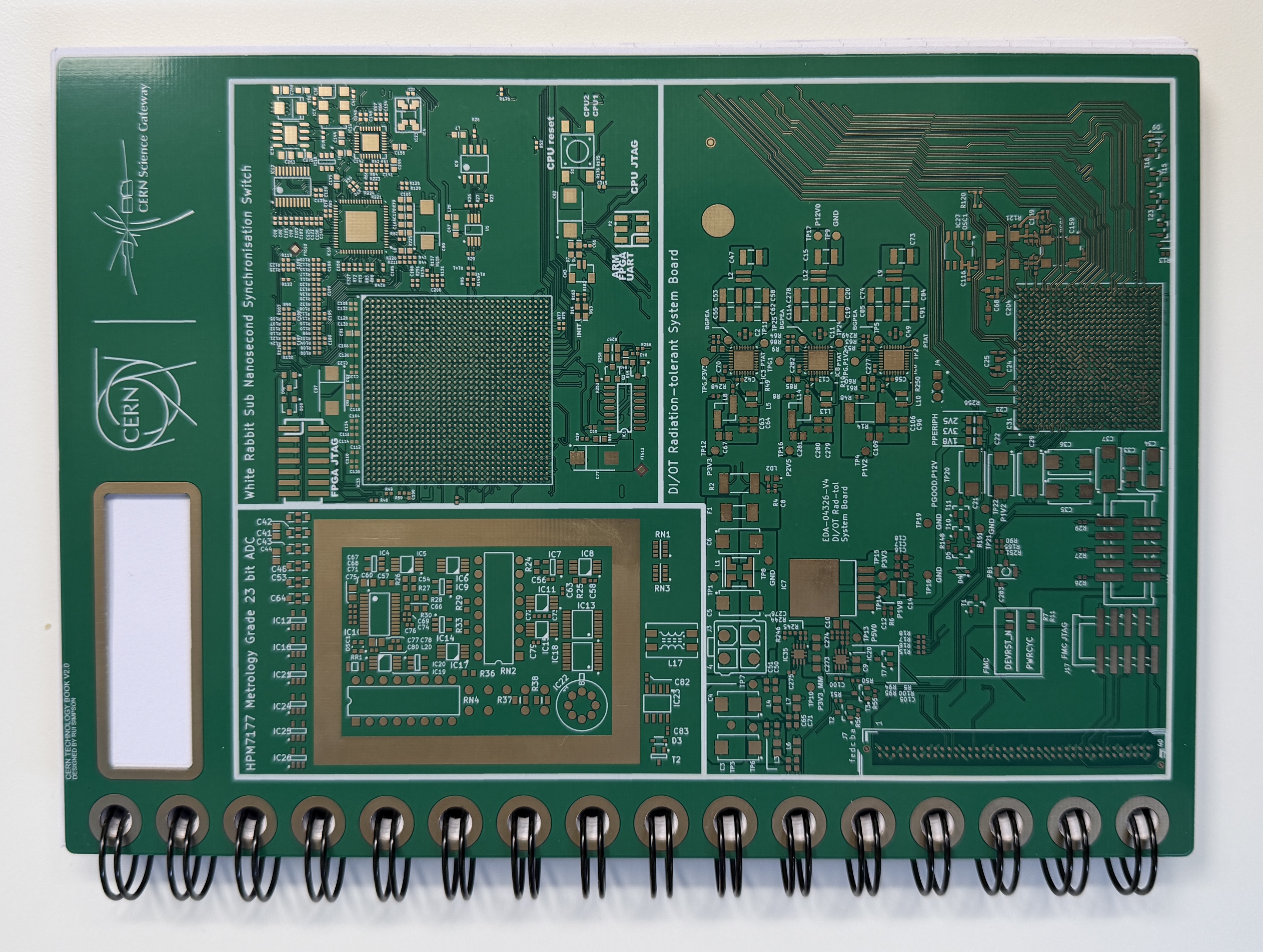
Technology Circuit Board Notebook — .CERN Hardware Projects
This notebook showcases some of CERN’s open source hardware projects.
HPM7177: The CERN accelerator complex relies on electromagnets powered by electricity to steer and focus the particle beams. Power supplies deliver thousands of amps to these magnets, but the current must be measured with an accuracy of 0.0001%, as even tiny variations would send the beams wildly off course. The HPM7177 enables this level of precision, matching the performance of metrology equipment at a fraction of the cost.
White Rabbit Hardware Switch: Controlling particles at near-light speed over the entire 27 km length of the LHC requires nanosecond timing precision. This presents a significant challenge as it takes many microseconds for electrical signals to travel between different parts of the LHC. The White Rabbit switch synchronises and time-stamps data measurements with sub-nanosecond accuracy and is now used in a wide variety of applications, including quantum research, telecommunications, finance and power grids.
Distributed I/OT Tier (DI/OT): Thousands of electronic devices are deployed throughout CERN's accelerators. Each device is different, making it challenging to maintain all the custom electronics required for each one to communicate with the control room. The DI/OT was designed to resolve this issue by replacing numerous custom designs with a single platform that can be customised for each application.
COMING SOON TO THE CERN SHOP
A5, 192 page of 80g, FSC certified paper,